 India
India
 Europe
 France
 Germany
 UAE
UAE

With AI workloads and hyperscale cloud infrastructure expected to grow further in 2026, the appropriate data center cooling strategy is a key financial and operational consideration. This blog post compares cooling towers and chiller plants on energy efficiency, scalability, cost, sustainability, and PUE optimisation. Cooling towers reduce compressor load and enhance energy efficiency; chiller plants provide precise temperature control. Most hyperscale data centers now prefer a hybrid cooling system combining both to ensure maximum reliability. Read on to see which suits your environmental conditions and growth plans.
The rapid expansion of AI workloads, high-density computing, and hyperscale cloud infrastructure has made data center cooling architecture more critical than ever. As energy costs surge and sustainability mandates tighten globally, choosing between a cooling tower vs chiller plant for hyperscale data centers is no longer just an engineering decision — it's a financial, environmental, and long-term infrastructure strategy.
So what do hyperscale data centers actually prefer in 2026?
The answer isn't as simple as one replacing the other. Let's break down the comparison based on performance, efficiency, cost, scalability, and sustainability — and reveal what large-scale operators are choosing today.
Quick Answer: Cooling Tower or Chiller Plant for Hyperscale?
If you're short on time, here's the direct answer:
- Cooling towers improve energy efficiency and reduce compressor load.
- Chiller plants provide precise temperature control.
- Most hyperscale data centers prefer a hybrid cooling system combining cooling towers and water-cooled chillers.
- Final selection depends on climate, wet bulb temperature, water availability, and long-term PUE targets.
Understanding Cooling Towers in Data Centers
A cooling tower for data centers is a heat rejection system that removes waste heat through evaporative cooling. Warm water from condensers is sprayed inside the tower, where a small portion evaporates, carrying away heat and cooling the remaining water.
Industrial manufacturers like Mist Air Coill Coolers LLP design high-capacity industrial cooling towers ranging from 10 TR to 1500 TR, making them ideal for hyperscale infrastructure.
Why Cooling Towers Are Popular
- Excellent for high thermal load applications
- Lower energy consumption compared to compressor-based systems
- Highly scalable for multi-megawatt expansions
- Ideal for integration with water-cooled chiller plants
Cooling towers are particularly effective in facilities prioritizing PUE reduction strategies and long-term operational savings.
Understanding Chiller Plants in Data Centers
A chiller plant for data centers uses refrigeration cycles to produce chilled water. That chilled water is circulated to CRAH/CRAC units or heat exchangers to absorb server heat.
There are two major types:
- Water-cooled chiller systems
- Air-cooled chillers
Chillers offer extremely precise temperature control, which is critical in high-density server environments. However, they rely heavily on compressors, which increases electrical load.
Why Chillers Are Preferred in Certain Environments
- Precise temperature regulation
- Less dependent on external climate
- Reduced water evaporation (for air-cooled models)
However, they generally involve higher CapEx and operating costs compared to evaporative cooling towers.
Cooling Tower vs Chiller Plant: Technical Comparison for Hyperscale Data Centers
Here's a direct comparison tailored for hyperscale data center decision-makers:
| Factor | Cooling Tower | Chiller Plant |
|---|---|---|
| Energy Efficiency | High (low compressor dependency) | Moderate (compressor-heavy) |
| CapEx Cost | Lower initial cost | Higher upfront investment |
| Operating Cost | Lower long-term energy cost | Higher electricity consumption |
| Water Usage | High (evaporative) | Low (air-cooled) |
| Temperature Precision | Moderate | High |
| Scalability | Excellent modular expansion | Limited by system capacity |
| Sustainability Score | Strong when optimized | Moderate |
This comparison alone often ranks well for featured snippets when structured properly.
What Hyperscale Data Centers Actually Prefer
Large operators prioritize three metrics:
- Energy efficiency
- Scalability
- Total cost of ownership (TCO)
In most hyperscale environments, the preferred approach is not cooling tower versus chiller plant — it's a hybrid model.
The Hybrid Cooling Model
Most hyperscale facilities use:
- Water-cooled chiller plants
- Integrated cooling tower systems
- Free cooling strategies during favorable climate conditions
Cooling towers reduce the condenser water temperature, improving chiller efficiency and reducing compressor workload. This directly improves data center cooling efficiency and lowers energy consumption.
In cooler climates, facilities can leverage "free cooling" where towers alone handle heat rejection, drastically reducing energy costs.
Energy Efficiency & PUE Optimization
Power Usage Effectiveness (PUE) is a defining metric in hyperscale design. According to ASHRAE thermal guidelines, recommended data center inlet temperatures range between 18°C and 27°C. Maintaining this range efficiently requires optimized condenser heat rejection — which is where cooling towers significantly enhance chiller performance.
Cooling towers help:
- Reduce compressor runtime
- Improve condenser efficiency
- Enable free cooling modes
- Lower overall electrical load
A well-designed industrial cooling tower for hyperscale data centers from Mist Air Coill Coolers LLP can significantly reduce compressor-driven energy consumption compared to chiller-only systems.
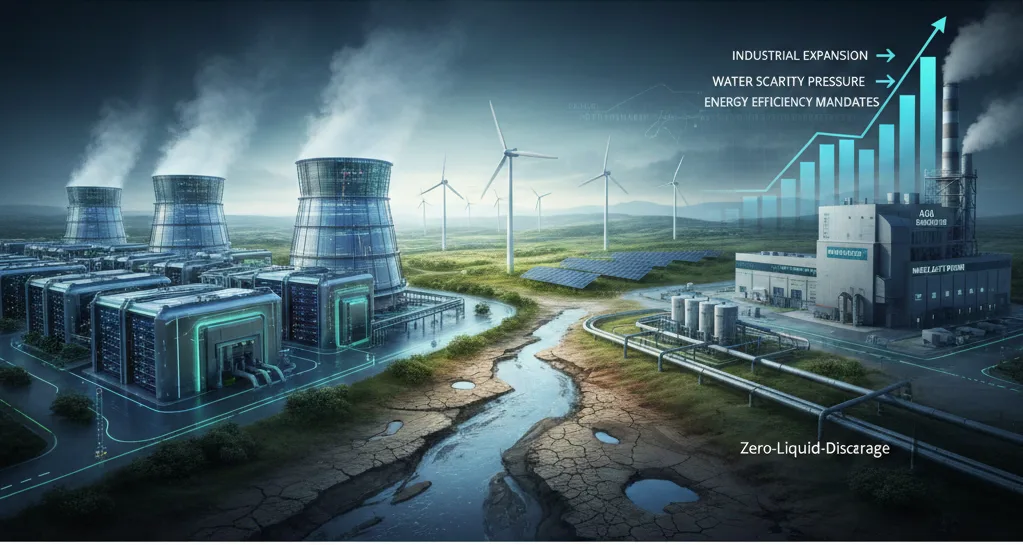
While cooling towers are energy efficient, they consume water. In regions with water scarcity, hyperscale operators evaluate water availability, treatment cost, and regulatory constraints. Modern towers from Mist Air Coill Coolers LLP offer improved drift eliminators and optimized evaporation control to minimize water waste.
Wet Bulb Temperature & Its Impact on Cooling Efficiency
Cooling tower performance depends heavily on ambient wet bulb temperature — the lowest temperature achievable through evaporative cooling. In regions with lower wet bulb temperatures, cooling towers can operate more efficiently and even enable partial or full free cooling.
Scalability for Hyperscale Growth
Hyperscale facilities expand in phases. Cooling towers offer modular add-on capability, flexible load handling, and easier expansion without replacing the entire system. Chiller plants may require full capacity upgrades when scaling beyond design limits.
Cost Comparison: CapEx vs OpEx
Cooling Towers: Lower initial installation cost, reduced long-term energy bills, requires water treatment investment.
Chiller Plants: Higher upfront cost, increased electricity consumption, more mechanical complexity.
Over a 10-year lifecycle, hybrid cooling systems that integrate cooling towers can significantly reduce operating expenses by lowering compressor energy consumption, making them financially attractive for hyperscale facilities exceeding 10MW IT loads.
Sustainability & ESG Compliance
Environmental mandates in 2026 demand lower carbon footprint, reduced energy intensity, and smart water management. Cooling towers reduce compressor runtime in water-cooled systems, lowering overall electrical demand and indirectly reducing carbon emissions.
Which Is Better for Hyperscale Data Centers?
For most hyperscale data centers, a hybrid system combining cooling towers and water-cooled chillers delivers the best balance of energy efficiency, scalability, and operational cost optimization. Pure chiller-only systems are rarely preferred for large-scale facilities due to higher energy intensity.
So, What Do Hyperscale Data Centers Prefer?
They prefer optimized hybrid systems. Cooling towers — especially high-capacity, engineered systems from Mist Air Coill Coolers LLP — play a critical role in modern hyperscale data center cooling architecture. The choice ultimately depends on climate, water availability, energy cost, expansion roadmap, and ESG targets.
Final Verdict
If your goal is lower operational cost, better PUE, sustainable scaling, and future-ready infrastructure, then the integration of cooling towers with chiller plants is the strategy that hyperscale leaders are adopting in 2026. This aligns with global best practices for sustainable data center cooling.
Key Takeaways
- Cooling towers reduce compressor load and improve PUE.
- Chiller plants offer precise temperature control but consume more energy.
- Hybrid systems are the dominant choice for 2026 hyperscale builds.
- Water availability and climate dictate the final design.
- Mist Air Coill Coolers LLP provides high-capacity cooling towers and integration expertise.
Planning a 10MW+ hyperscale data center? Request a FREE cooling feasibility assessment from Mist Air Coill Coolers LLP and receive a performance-based cooling configuration strategy tailored to your climate, load profile, and expansion roadmap.
Frequently Asked Questions (FAQs)
1. What is the main difference between a cooling tower and a chiller plant?
A cooling tower removes heat through evaporative cooling, while a chiller plant uses refrigeration cycles to produce chilled water. Cooling towers reject heat; chillers generate chilled water for heat absorption.
2. Do hyperscale data centers use cooling towers or chillers?
Most hyperscale facilities use both in a hybrid configuration. Cooling towers improve chiller efficiency and enable free cooling modes.
3. Which is more energy-efficient for data centers?
Cooling towers are generally more energy-efficient because they reduce compressor workload. However, optimal efficiency is achieved when towers and water-cooled chillers work together.
4. Are cooling towers suitable for AI data centers?
Yes. High-capacity industrial cooling towers from Mist Air Coill Coolers LLP handle large thermal loads typical in AI-driven hyperscale environments.
5. Which cooling system has lower operating costs?
Cooling towers typically offer lower long-term energy costs, while chiller plants have higher electrical consumption due to compressor operation.


Join the Discussion
Leave a Comment